Incremental RTS Economy Guide
Shared factory costs, purge discipline, Sunflowers, and saving-time math.
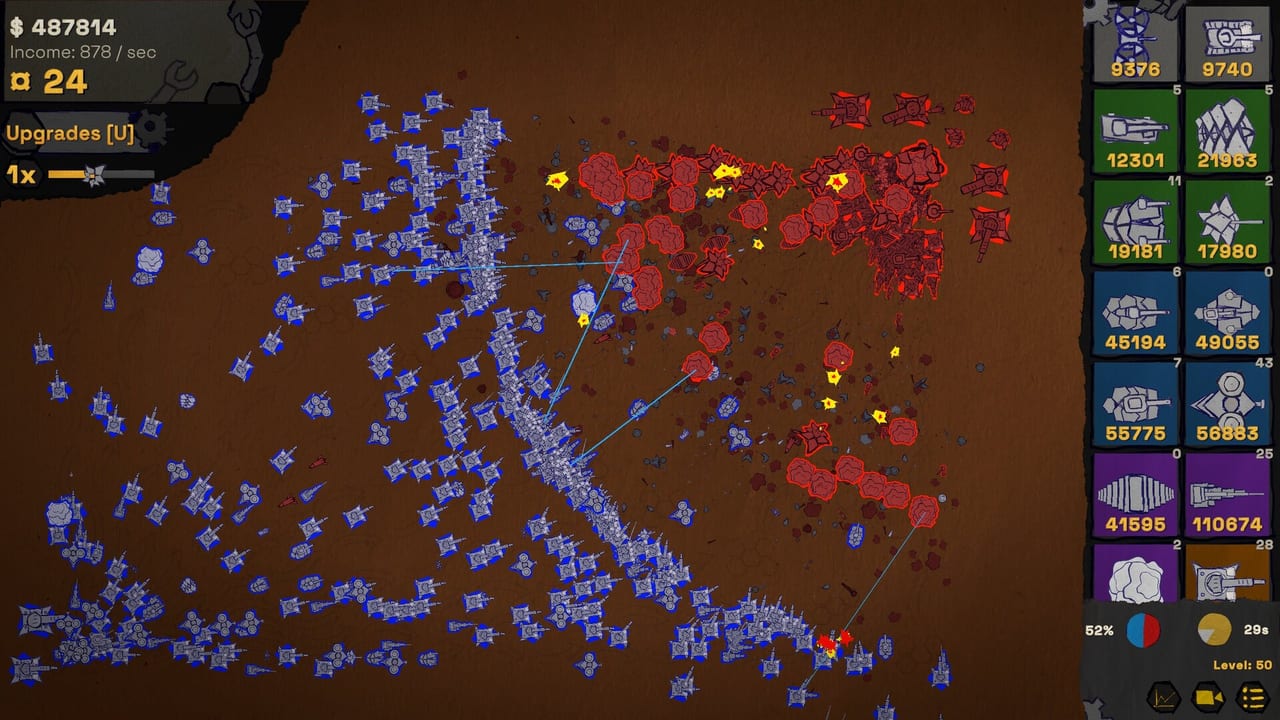
Economy is the real battlefield in Incremental RTS. Combat looks loud — swarms, artillery, tanks — but most failed runs start in the right-hand factory panel. This guide covers shared building costs, purge discipline, Sunflowers as resource producers, and a simple saving-time formula you can use with the Factory Calculator. Pair it with How to Play for loop context and Getting Started for day-one controls.
The shared cost rule (non-negotiable)
The developer states that each building increases the cost of all buildings. That means:
- Buying a cheap factory raises the price of the expensive factory you were saving for.
- “Just one more” impulse buys are not free side grades; they tax every future purchase.
- Your opportunity cost is measured in delayed key lines, not only in the coins you spent.
Always read the current price of the factory you care about after every purchase. Do not plan from a screenshot taken ten buys ago.
Factories on the right panel
Factories are purchased from the right panel. Hold Ctrl (Windows) or Cmd (macOS) to multi-buy when you intentionally want volume of one type. Multi-buy is a power tool, not a default — each click still pushes the shared curve. Zoom and pan with wheel and drag so you can see whether new production is actually reaching the fight you meant to reinforce. Hotkey details sit on Controls.
Ask three questions before every buy:
- Does this factory type address the current battlefield problem? (income, swarm density, anti-air, siege, etc.)
- What does this do to the next factory I actually need?
- Would waiting 30–60 seconds on higher income be cheaper than buying junk now?
If you cannot answer those, wait. Idle time with rising income is often stronger than a panic purchase.
Sunflowers replaced Briars
A major update replaced Briars with Sunflowers as resource producers. That is a different role from sending another fighting unit to the front. Practical implications:
- Older guides that say “spam Briars” are stale — translate the intent to income producers, then verify in your build.
- Sunflowers compete for the same shared cost budget as combat factories. Spamming them without a plan can lock you out of the tank or artillery line you needed for the next base.
- Think of Sunflowers as engine parts. They exist to shorten the wait for meaningful combat purchases and upgrades.
There is no universal public “always buy N Sunflowers first” number from the developer. Match producer count to how hard your next combat factory is to afford.
Purge: economy reset, not death
The developer recommends purging periodically because building prices rise. Important distinctions:
| Action | What it is for | What it is not |
|---|---|---|
| Purge | Relieve shared price spiral during a run | A substitute for learning cost discipline |
| Death | Progression reset: keep upgrades & war points, lose factories, earlier level | An economy “refund button” |
Do not purge solely because a calculator shows a long wait. The calculator measures affordability under current income; it does not know your combat state or what a purge will remove in your build. If the UI does not clearly state retained resources, keep the run intact and check official notes via Updates or community channels on Links.
Death rules are expanded on Death and Progression. After death, the empty factory board is intentional so you can rebuild with new factory types unlocked through research.
Saving-time formula
Use the same currency for every input — match the factory price and the income counter in your current build.
Estimated saving time = max(0, price − balance) ÷ income per second
Example: price 3,000, balance 1,000, income 50 per second → (3,000 − 1,000) ÷ 50 = 40 seconds.
Assumptions and limits:
- Income stays constant while you wait (no other spending, no producer changes).
- It estimates time to afford, not factory payback period, combat value, or purge timing.
- When prices jump after another purchase, recompute with fresh numbers.
The on-wiki Factory Calculator encodes this idea for quick checks. Treat long ETAs as a signal to improve income (Sunflowers / economy upgrades) or to stop buying off-plan factories — not as an automatic reset order.
Working with upgrades and combat
Economy decisions feed the Upgrades Guide. Coin rewards and interest change how fast balances grow; Apex and search help you find income nodes in a 300+ upgrade tree. Likewise, army identity on the Tier List Hub only matters if you can still afford the factories that spawn those units. A Mosquito-heavy plan fails if shared costs locked the air line behind a wall of impulse buys — see Mosquito vs Woodlouse and Army Builds after your economy is stable.
Practical economy checklist
- Name the next one factory that matters for the fight.
- Check its live price and your income; run the saving-time formula.
- Prefer Sunflowers / income upgrades when ETA is painful and combat is stable enough to wait.
- Avoid multi-buy spam unless the volume clearly wins the current wave.
- When the whole board’s prices feel absurd, consider purge if you understand what you lose — else stabilize and read official guidance.
- After death, rebuild lean: producers first, then the combat lines your persisted upgrades now support.
Common mistakes
- Buying every unlocked factory “to try it.” Shared costs punish tourism. Lab one new line at a time.
- Treating producers like soldiers. Sunflowers fund the war; they are not a substitute for artillery when a wall needs breaking.
- Equating long save timers with mandatory purge. Fix income or stop leaking purchases first.
- Ignoring Ctrl/Cmd multi-buy discipline. Faster clicks can dig a deeper cost hole.
- Planning from demo habits on the full Steam release. Roster and upgrade count are larger; revisit prices live.
Where to go next
Return to the Guides Hub for the full index. Refresh loop fundamentals in How to Play, then spend currency wisely with the Upgrades Guide. For platform quirks and Level 24+ play, use Death and Progression. Storefront and Discord links remain on Links and the Wiki overview.
Master shared costs and Sunflowers, and Incremental RTS stops feeling like a random number generator — it becomes a timing puzzle you can solve.
Frequently Asked Questions
Quick answers to the most common questions.
Why did unrelated factories get more expensive?
Each building raises the cost of all buildings. Check the live price of your target factory after every purchase.
What are Sunflowers?
Resource producers that replaced Briars. Build them for income, not as primary frontline fighters.
Is purge the same as dying?
No. Purge addresses the shared price spiral during a run. Death keeps upgrades and war points, deletes factories, and returns you to an earlier level.
How do I estimate time until I can afford a factory?
Use max(0, price − balance) ÷ income per second with matching currency units. The Factory Calculator helps.
Should a long saving-time result trigger an instant purge?
No. It only measures affordability. Improve income or stop off-plan buys before resetting.